

When you start researching residential lifts, two terms appear repeatedly in product comparisons and buyer guides: hydraulic and pneumatic. Both are presented as viable options for home use. Both have their advocates. And yet the differences between them — in performance, practicality, cost, and long-term suitability for Asian residential conditions — are significant enough that choosing the wrong one for your home could mean years of regret.
The problem is that most comparisons available online either treat both technologies as roughly equivalent — which they are not — or are written by providers who have a vested interest in steering you toward whichever system they happen to sell. What Malaysian and Indian homeowners actually need is a technically honest, practically focused comparison that explains how each system works, what it delivers in real-world daily use, and which situations genuinely suit each technology.
That is exactly what this guide provides. By the time you finish reading, you will have a clear, accurate understanding of hydraulic residential lifts and pneumatic residential lifts — their respective strengths, limitations, and the situations where each technology is genuinely the right choice for a residential installation.

Recommended Reading
No recommended reading posts found.How Hydraulic Residential Lifts Work: The Technology Explained
A hydraulic residential lift uses a fluid-powered mechanism to move the cabin vertically between floors. The system consists of a hydraulic control unit, a pump, a cylinder or chain transmission mechanism, and a cabin. When the pump activates, it pressurises fluid within the system, which drives the cylinder or chain to raise the cabin. When descending, the fluid is released in a controlled manner, allowing the cabin to lower smoothly under gravity.
The most advanced hydraulic systems used in premium residential lifts — including the Elite E200 and X200 range — use a hydraulic chain drive configuration with patented Greaseless Rail technology that eliminates the need for lubricant application on guide rails or mechanical components. This removes the traditional maintenance burden associated with hydraulic systems and delivers a consistently clean operation profile that suits domestic environments.
Hydraulic residential lifts typically operate at speeds of 0.15 to 0.30 m/s, support load capacities of up to 400 kg, and run on standard single-phase power supply — making them highly compatible with typical residential electrical infrastructure in both Malaysia and India. Their soft-start and soft-stop technology delivers smooth, jerk-free travel that is well suited to diverse passenger groups including elderly family members and young children.

Move Smarter, Not Harder.
Better, Faster, Quieter, Safer & Easier Movements Just One Call Away!
How Pneumatic Residential Lifts Work: The Technology Explained
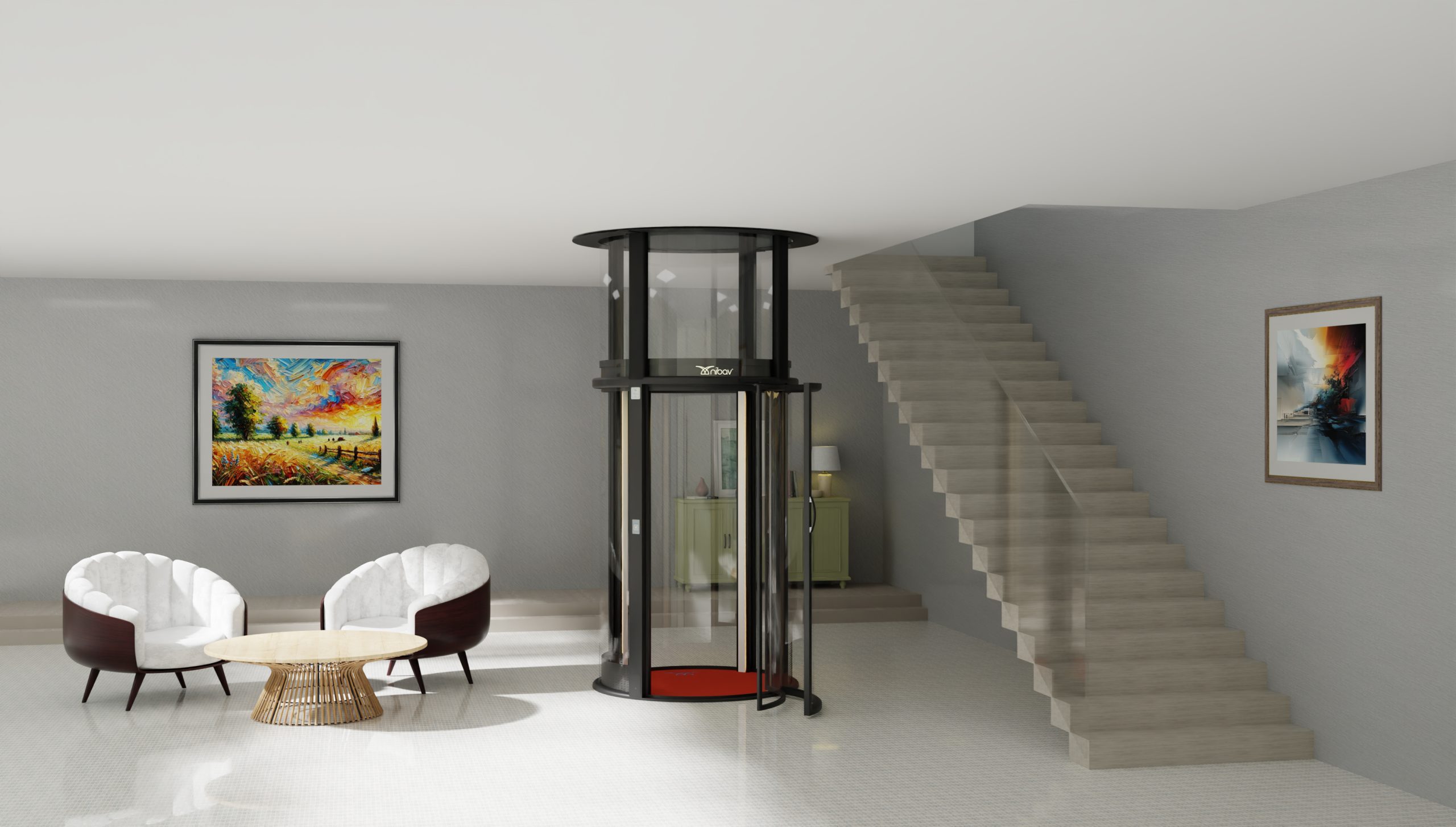
A pneumatic residential lift — also called a vacuum elevator or air-driven elevator — operates on air pressure differences rather than a mechanical drive system. The cabin travels inside a transparent cylindrical tube. When air is removed from above the cabin by a turbine, the resulting pressure differential lifts the cabin upward. To descend, air is slowly reintroduced above the cabin, allowing it to lower under its own weight in a controlled manner.
Pneumatic lifts are visually striking — their transparent cylindrical design creates a distinctive aesthetic that appeals to homeowners seeking a statement installation. They require no shaft, no pit, and no machine room, and can be installed with minimal structural modification in many existing homes.
However, pneumatic residential lifts have significant practical limitations that become apparent in real-world daily use. They typically support a maximum load of 160–200 kg — insufficient for multiple adult passengers or for passengers using wheelchairs. Travel speed is lower than hydraulic systems. The turbine mechanism that creates the pressure differential produces a level of operational noise that many homeowners find intrusive in a domestic environment. And the cylindrical tube design severely limits cabin size and customisation options, ruling out the personalised interior finishes that most Asian homeowners expect from a premium residential lift installation.
Hydraulic vs Pneumatic Residential Lifts: Head-to-Head Comparison
The following comparison covers the factors that matter most for Malaysian and Indian homeowners making a residential lift decision:
| Factor | Hydraulic Lift | Pneumatic Lift |
| Load Capacity | Up to 400 kg | Typically 160–200 kg |
| Speed | 0.15–0.30 m/s | 0.10–0.15 m/s (typically) |
| Noise Level | Whisper-quiet operation | Audible turbine noise during operation |
| Cabin Customisation | Extensive — 16 RAL colours, glass, wood, LED finishes | Very limited — fixed cylindrical transparent tube |
| Max Floors | Up to 6 stops | Typically 2–3 stops maximum |
| Safety Certification | EN 81-41 certified | Certification varies widely by product |
| Power Failure Safety | Battery-operated ARD — safe floor exit | Gravity descent — variable safety profile |
Why Hydraulic Lifts Dominate the Residential Lift Market in Malaysia and India
The residential lift markets in both Malaysia and India are overwhelmingly dominated by hydraulic systems — and this is not simply a matter of familiarity or inertia. It reflects a genuine alignment between hydraulic technology’s practical characteristics and the specific requirements of residential lift use in South and Southeast Asian homes.
Malaysian and Indian households tend to be multi-generational, with diverse passenger groups including elderly family members, young children, pregnant women, and family members with varying mobility needs. The 400 kg load capacity, smooth soft-start travel, and whisper-quiet operation of quality hydraulic lifts serve all these passengers equally well — something a pneumatic system with its 160–200 kg capacity and audible turbine noise cannot reliably deliver.
The extensive cabin customisation options available on hydraulic residential lifts — 16 RAL colour finishes, glass and wood wall options, LED ceiling configurations, and personalised flooring choices — also align far better with the expectations of Asian homeowners who treat their home elevator as an interior design element, not just a functional installation. Pneumatic lifts, confined to their fixed cylindrical tube design, simply cannot compete on this dimension.
Elite Elevators Malaysia’s hydraulic range — comprising the E200 and X200 series — is specifically engineered for Asian residential conditions, with single-phase power compatibility, Greaseless Rail technology for maintenance-free operation, battery-operated Automatic Rescue Devices for power failure safety, and EN 81-41 European safety certification as standard across every model.
When Does a Pneumatic Residential Lift Make Sense?
Given the practical limitations outlined above, are there situations where a pneumatic residential lift is genuinely the right choice? The honest answer is yes — but the situations are specific and relatively narrow.
A pneumatic lift may be worth considering for a single-occupant or small household where the 160–200 kg load capacity is not a practical constraint, where the property has very limited space for a conventional shaft installation, where the cylindrical design is actively desired as an architectural statement feature, and where the home has only two floors to serve.
For the vast majority of Malaysian and Indian homeowners with multi-generational households, multi-floor properties, and expectations of a customised, quiet, high-capacity residential lift — hydraulic systems deliver a comprehensively more suitable solution. The load capacity, noise profile, customisation flexibility, floor range capability, and safety certification profile of quality hydraulic lifts make them the appropriate choice for most residential applications in both markets.
Frequently Asked Questions: Hydraulic vs Pneumatic Residential Lifts
- Which is better for a family home — a hydraulic or pneumatic lift?
For most family homes in Malaysia and India, a hydraulic lift is the better choice. Its 400 kg load capacity serves multiple passengers simultaneously, its whisper-quiet operation suits domestic environments, and its extensive customisation options align with residential interior design expectations. Pneumatic lifts are better suited to single or small households with limited space and a preference for a transparent cylindrical aesthetic. - Are hydraulic lifts safe during power failures?
Yes — provided the hydraulic lift is fitted with a battery-operated Automatic Rescue Device, which is standard on quality hydraulic residential lifts including Elite Elevators Malaysia’s E200 and X200 range. The ARD automatically moves the cabin to the nearest floor during a power interruption, allowing passengers to exit safely without requiring any external assistance. - Do hydraulic lifts require lubricant or regular fluid changes?
Advanced hydraulic lifts using patented Greaseless Rail technology — such as Elite Elevators Malaysia’s E200 — require no lubricant application on guide rails or mechanical components throughout their operational lifespan. This eliminates the traditional maintenance burden associated with conventional hydraulic systems and delivers a consistently clean domestic environment. - Can a pneumatic lift support wheelchair users?
The limited load capacity of most pneumatic residential lifts — typically 160–200 kg — and their narrow cylindrical cabin design make them unsuitable for wheelchair use in most configurations. A hydraulic residential lift with its 400 kg capacity and larger cabin dimensions is significantly more appropriate for households requiring wheelchair accessibility. - How noisy is a hydraulic lift compared to a pneumatic one?
Quality hydraulic residential lifts — particularly those using soft-start technology and Greaseless Rail systems — operate at near-silent levels that are entirely unobtrusive in a domestic environment. Pneumatic lifts produce audible turbine noise during operation as the vacuum mechanism activates, which many homeowners find noticeably intrusive in a quiet residential setting.
