


Ask five lift salespeople which technology is best for a home elevator and you will get five different answers — all shaped by what they sell. The hydraulic vs pneumatic elevator debate has real substance to it, and the honest answer is not a diplomatic ‘both have merits.’ For most residential applications, particularly in existing homes, one technology is demonstrably better suited. What follows is a fact-based comparison that does not favour either side for commercial reasons.
The frustration for homeowners is understandable. Both types are marketed with enthusiasm. Both have genuine strengths. But the decision criteria — installation requirements, cost structure, maintenance burden, energy efficiency, design flexibility, and long-term reliability — play out very differently between them. And the wrong choice for your specific situation is a decision you will live with for decades.
This guide works through the comparison systematically, category by category, so that by the end you have a clear, reasoned answer for your specific home and situation — not a generic recommendation.

How Each Technology Actually Works
Understanding the mechanical principles behind each type is the foundation for a meaningful comparison.
Hydraulic elevators
A hydraulic system uses an oil-driven piston or rams to raise the elevator cabin. An electric pump pressurises hydraulic fluid, which extends the piston and lifts the cabin. Descent is controlled by releasing the fluid back to the reservoir. The motor and fluid reservoir typically sit in a machine room separate from the shaft, and the mechanism requires a pit below the ground floor to accommodate the piston at its lowest position.
Air-driven / pneumatic vacuum elevators

Move Smarter, Not Harder.
Better, Faster, Quieter, Safer & Easier Movements Just One Call Away!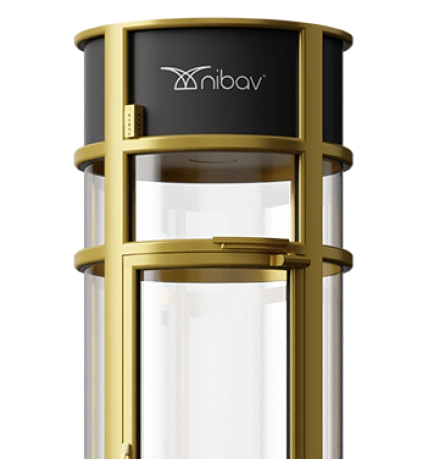
A pneumatic lift operates using air pressure differentials. A vacuum is created above the cabin by a turbine at the top of the cylinder, causing atmospheric pressure below to push the cabin upward. Descent is achieved by slowly releasing the vacuum — gravity and controlled air flow lower the cabin smoothly. The entire mechanism is self-contained within the cylinder. No pit, no machine room, no external hydraulic reservoir.
Installation: The Single Biggest Differentiator
If you are installing a lift in an existing home — which describes the majority of residential elevator buyers — installation requirements are where the comparison is most decisive.
Hydraulic lift installation in an existing home requires:
- A pit — typically 500 mm to 1,500 mm deep — requiring the ground floor slab to be broken and excavated
- A dedicated machine room — typically the size of a small bedroom — for the motor, pump, and fluid reservoir
- A fully enclosed shaft built into or alongside the home’s structure
- 4 to 12 weeks of active construction, often requiring partial vacation of the home
- Additional civil construction costs of MYR 50,000 to MYR 100,000 or more on top of the unit price
Air-driven lift installation in an existing home requires:
- A flat floor surface in a clear space of approximately 1,000 mm to 1,430 mm
- Circular floor openings cut between each level the lift serves
- A standard electrical connection (3.7 kVA)
- 4 to 5 working days of clean, quiet installation
- Zero additional civil construction budget
Verdict: Air-driven lifts win this category comprehensively for retrofit installations. For new-build homes where a shaft and pit can be designed from the outset, hydraulic remains viable — but the advantage narrows significantly.
Cost: The Honest Numbers
On headline unit price, hydraulic and air-driven lifts can appear competitive. The difference emerges when total cost of ownership is calculated honestly:
- Air-driven total cost (MYR): Unit + installation, MYR 69,900 to MYR 1,79,900. Civil construction: MYR 0. Annual maintenance: Low. Energy: Ascent only.
- Hydraulic total cost (MYR): Unit, MYR 80,000 to MYR 200,000+. Civil construction, MYR 50,000 to MYR 100,000+. Annual maintenance, MYR 3,000 to MYR 8,000. Energy: Both directions.
Over a 10-year horizon, a mid-range air-driven lift typically costs 40% to 60% less in total than a comparable hydraulic installation — primarily due to eliminated civil construction and lower ongoing maintenance costs.
Verdict: Air-driven lifts offer materially lower total cost of ownership for existing homes. The gap widens further when energy consumption is included.
Maintenance and Reliability: The Long Game
Hydraulic elevators require regular maintenance because of their mechanical complexity:
- Hydraulic fluid changes and leak inspections — fluid contamination is an environmental risk
- Piston seal replacement over time
- Pump motor servicing and valve maintenance
- Machine room climate control requirements in hot, humid environments like Malaysia
Air-driven elevators have a fundamentally simpler maintenance profile:
- No hydraulic fluid — no leaks, no environmental risk, no disposal cost
- No cables, pulleys, or counterweights — common hydraulic failure points absent
- No lubrication schedule — the mechanism is grease-free
- Approximately 90% lower maintenance cost than hydraulic alternatives
Verdict: Air-driven lifts have significantly lower maintenance burden. For homeowners in Malaysia and Southeast Asia — where humidity and temperature accelerate hydraulic component wear — this advantage is particularly meaningful.
Design, Aesthetics and Capacity: Where Hydraulic Has Ground
In the interests of genuine balance, here are the areas where hydraulic lifts retain meaningful advantages:
Higher maximum capacity: Hydraulic lifts can be engineered to support 400 kg or more — well above the 240 kg ceiling of current residential vacuum lift designs. For homes with very high-capacity requirements, this matters.
Custom cabin dimensions: Because hydraulic lifts use a purpose-built shaft, the cabin can be engineered to bespoke dimensions. Pneumatic lifts are constrained to the available cylinder sizes — typically 830 mm or 1,240 mm internal diameter.
Ride quality at very high speeds: For buildings with four or more floors and frequent high-throughput use, traction and hydraulic systems can deliver smoother high-speed rides than current residential vacuum designs.
The practical significance of these advantages in a typical Malaysian residential context — two to four floors, 1 to 3 occupants per trip, normal speed requirements — is limited. For the vast majority of homeowners, these do not change the recommendation.
The Verdict: Which Is Better for Most Malaysian Homes?
For existing residential properties in Malaysia, Singapore, India, and the broader Southeast Asian region — which represent the overwhelming majority of the home elevator market — air-driven vacuum lifts are the demonstrably better choice across installation, cost, maintenance, and design flexibility.
Hydraulic lifts retain relevance for purpose-built new-construction projects where a shaft can be designed in from the outset, very high capacity requirements exist, or custom cabin dimensions are needed. Outside these specific conditions, the pneumatic vacuum elevator is the more practical, more affordable, and increasingly more elegant solution.
Making the Right Choice for Your Home
The hydraulic vs pneumatic elevator debate, when evaluated honestly against the real-world requirements of most residential buyers, tends to resolve itself. For homeowners in existing multi-storey homes across Malaysia, Singapore, India, or Southeast Asia — which represent the largest segment of the market — the practical advantages of air-driven lifts are decisive: faster installation, lower total cost, minimal structural disruption, lower ongoing maintenance, and increasingly sophisticated design options.
For those building from scratch with a large budget, generous timeline, and specific requirements that exceed the capacity or dimension limits of current vacuum lift designs, hydraulic systems remain a considered option. But these conditions describe a small minority of residential elevator buyers.
The clearest recommendation: visit a lift experience centre, ride both types if possible, bring your home’s floor plan, and request itemised quotes that include all costs — unit, installation, civil works, and annual maintenance. The numbers will tell the story more clearly than any promotional material from either side of the debate.
Frequently Asked Questions
1. Is an air-driven home lift as safe as a hydraulic elevator?
A: Yes. Leading air-driven residential lifts carry TÜV NORD European safety certification and include emergency descent, triple-layer door safety, overload protection, 30-minute battery backup, and precision braking systems. Their safety profile is equivalent to or better than most residential hydraulic installations.
2. Can a pneumatic elevator be installed in any existing home?
A: In the vast majority of cases, yes. A free site feasibility assessment from a reputable supplier will confirm suitability. The compact footprint (from 1,000 mm clear space) and self-supporting design make them suitable for terrace homes, semi-Ds, bungalows, townhouses, and villas.
3. What is the maximum weight capacity of an air-driven home lift?
A: Current residential vacuum lifts support up to 210 kg (Standard models) and 240 kg (Max models). This covers 2 to 3 adult occupants or a wheelchair user with an attendant — sufficient for the vast majority of residential use cases.
4. Does a vacuum elevator use a lot of electricity?
A: No. Pneumatic lifts consume power only during ascent. Descent is powered by gravity and controlled air release — consuming zero additional electricity. The operating cost is comparable to a standard home appliance, significantly lower than hydraulic systems which consume power in both directions.
5. Which is quieter — hydraulic or air-driven?
A: Modern air-driven lifts are notably quieter in operation than hydraulic alternatives. The pneumatic mechanism produces minimal sound during travel, and leading models include acoustic insulation that makes them suitable even for open-plan or compact homes where noise travels easily.
