


You’re standing in your newly built three-storey home in Kuala Lumpur, wondering how to make daily movement between floors easier — not just for you today, but for every member of your family for the next twenty years. The lift decision you make now will affect your home’s structure, your energy bills, your maintenance routine, and your quality of life. So the question is not just “should I install a lift?” — it’s “which type makes the most sense?”
Pneumatic home elevators and conventional elevators in Malaysia serve the same fundamental purpose but differ significantly in how they achieve it, how they are installed, and what they demand from your home long-term. Nibav Home Lifts Malaysia, certified by TÜV NORD and ISO, specialises in pneumatic air-driven home lift technology designed specifically for the residential context — and understanding the difference between these two systems is the first step toward making the right choice.
Key Takeaways
- Pneumatic lifts use air pressure to move the cabin — requiring no grease, no cables, no pit, and no separate machine room.
- Conventional elevators rely on hydraulic fluid or cable-traction systems that require significant civil infrastructure.
- Nibav pneumatic lifts can be installed in just 3–5 working days with no pit or machine room required.
- Nibav pneumatic elevators consume power only while ascending — zero energy is used on descent.
- Both types can serve multi-floor Malaysian homes, but pneumatic systems carry distinct advantages for existing properties and retrofits.
What Is a Pneumatic Home Elevator and How Does It Work?
A pneumatic home elevator — also called a vacuum elevator or air-driven lift — operates using controlled differences in air pressure above and below the cabin. When air pressure above the cabin is reduced, the cabin rises. When pressure equalises, the cabin descends using gravity alone.
There are no cables, no grease, no counterweights, and no complex mechanical infrastructure. The system is largely self-contained within its own structural column, making it genuinely independent of your home’s walls, floor slabs, or load-bearing structure.

What Makes Pneumatic Technology Different
- No hydraulic fluid — cleaner, no leak risk, no grease-related maintenance
- Self-supporting structure — no shaft construction required
- Gravity-assisted descent — consumes zero energy going down
- Quiet operation – suited to residential environments
What Is a Conventional Elevator and How Does It Differ?
Conventional elevators in Malaysia typically fall into two categories: hydraulic lifts (which use fluid-filled pistons to push the cabin up) and traction lifts (which use steel cables and counterweights driven by an electric motor). Both are well-established technologies — but both were developed primarily for commercial and multi-storey building use.
When adapted for residential homes, they bring significant requirements: a dedicated machine room, a structural shaft, a deep pit beneath the ground floor, and extensive civil work that can take weeks or months to complete.
Core Differences at a Structural Level
| Feature | Pneumatic Lift | Conventional Elevator |
| Drive system | Air pressure (pneumatic) | Hydraulic fluid or cables |
| Pit required | No | Yes — deep pit needed |
| Machine room | No | Usually required |
| Installation time | 3–5 working days | Weeks to months |
| Energy use | Power only on ascent | Continuous power |
| Maintenance | Minimal — no grease, less after work | Regular servicing required |
| Suitable for existing homes | Yes | Requires major modification |
| Environmental impact | Low — grease-free, energy-efficient | Higher — lubricants, counterweights |
Why Are Pneumatic Lifts Becoming a Popular Conventional Elevator Alternative in Malaysia?
Malaysia’s residential landscape — landed bungalows in Johor Bahru, duplex townhouses in Penang, multi-storey villas in Kuala Lumpur — presents a consistent challenge: most homes were not originally built with conventional elevator infrastructure in mind. Retrofitting a traditional lift into a finished home often means structural work, extended timelines, and significant disruption.

Move Smarter, Not Harder.
Better, Faster, Quieter, Safer & Easier Movements Just One Call Away!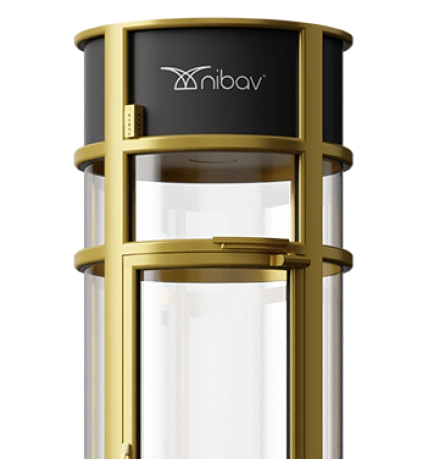
Nibav’s pneumatic elevator is a lightweight, standalone structure made of aluminium and polycarbonate — and it can be installed in existing homes without any structural work, regardless of whether the property is a bungalow, duplex, or penthouse.
For a family whose parents are ageing, or who simply want the convenience of multi-floor mobility without a multi-month construction project, this distinction is decisive.
How Do Pneumatic Lifts Perform on Safety Compared to Conventional Systems?
Safety is where many homeowners assume conventional elevators hold an advantage — simply because they are more familiar. But the engineering reality is more nuanced.
Nibav’s air-driven pneumatic engineering simplifies traditional lift mechanics. Compared to cable-heavy systems, pneumatic lifts involve reduced mechanical complexity, which can improve long-term reliability — especially in tropical environments like Malaysia.
Safety Features in Nibav Pneumatic Systems
- Automatic emergency descent: Whenever there is a power failure, the elevator descends to the nearest floor safely.
- Smart overload sensors: Prevent operation beyond rated capacity
- Emergency stop and alarm system: Provides immediate user control
- Child lock: Prevents unsupervised operation by children
- Multiple pressure seals and air valves: Maintain stability and prevent sudden movement
Nibav’s TÜV NORD-certified lifts and ISO certified production facility reflect a commitment to delivering safe, reliable, and high-quality home elevators — with every step from design to delivery following globally approved quality processes.
When Should You Choose a Pneumatic Lift Over a Conventional Elevator?
The choice becomes straightforward when you consider three practical factors: your home’s current structure, your installation timeline, and your long-term maintenance appetite.
Choose a Pneumatic Lift When:
- Your home is already built, and retrofitting a conventional system would require major structural changes.
- You want installation completed within days, not weeks.
- You prioritise low maintenance and minimal ongoing servicing.
- Energy efficiency and environmental impact matter to your household.
- Space is limited — Nibav’s compact models require only 1000 mm to 1430 mm of clear space.
Consider a Conventional Elevator When:
- You are building a new commercial-scale residential property from the ground up with shaft space pre-allocated.
- You require very heavy load capacities above standard residential needs.
- Long-term preference for a specific traditional traction system drives the decision.
For the vast majority of Malaysian homeowners — particularly those upgrading existing homes — the pneumatic alternative offers a combination of benefits that conventional systems simply cannot match in a residential context.
How Much Does a Pneumatic Home Elevator Cost in Malaysia vs a Conventional System?
Upfront cost comparisons between pneumatic and conventional elevators are often misleading because they exclude the true cost of conventional installation: civil works, shaft construction, machine room buildout, and extended project timelines.
Nibav home elevator costs in Malaysia typically range from MYR 69,900 to MYR 179,900 depending on the size and model. This price includes the full self-supporting structure, safety systems, and installation — without additional civil work costs layered on top.
A conventional elevator for residential use, when civil infrastructure costs are included, typically far exceeds this range — plus carries higher recurring maintenance costs due to lubricant, mechanical components, and regular servicing requirements.
FAQs: Pneumatic Lifts vs Conventional Elevators in Malaysia
- What is the main difference between a pneumatic lift and a conventional elevator in Malaysia?
A pneumatic lift uses air pressure and requires no pit, shaft, or machine room, making it ideal for existing homes. Conventional elevators use cables or hydraulic systems and require significant civil infrastructure, better suited to purpose-built installations.
- Are pneumatic home elevators in Malaysia safe for daily family use?
Yes — Nibav’s TÜV NORD-certified lifts and ISO certified manufacturing facility ensure every unit meets globally approved safety and quality standards. Multiple built-in safety features protect users during power failures and emergency situations.
- How long does a pneumatic elevator take to install compared to a conventional lift?
Nibav pneumatic elevators can be installed in just 3–5 working days with no pit or machine room required — significantly faster than conventional systems, which typically require weeks of civil work.
- Is a pneumatic elevator more energy-efficient than a conventional elevator?
Yes. Pneumatic elevators consume power only while ascending — zero energy is used on descent, making them among the most energy-efficient residential lift options in Malaysia.
- Can a pneumatic lift be installed in an existing Malaysian home without major renovation?
Yes — pneumatic compact elevators are suitable for retrofitting into existing homes due to minimal structural requirements. The self-supporting design means no walls need to be opened or floor slabs modified.
Pneumatic Is the Smarter Residential Choice for Malaysian Homes
The comparison between pneumatic lifts and conventional elevators in Malaysia ultimately comes down to purpose. Conventional systems were built for commercial buildings first — and carry all the infrastructure requirements that entails. Pneumatic systems were engineered specifically for homes, which is why they install faster, maintain easier, consume less energy, and fit into spaces that conventional lifts simply cannot reach. Nibav Home Lifts Malaysia brings all of this together under a single certified, trusted platform — making the decision not just practical but straightforward.
